
'/%3E%3C/svg%3E)






The Future of AI in Manufacturing: Scaling From the Factory Floor to B2B eCommerce Operations
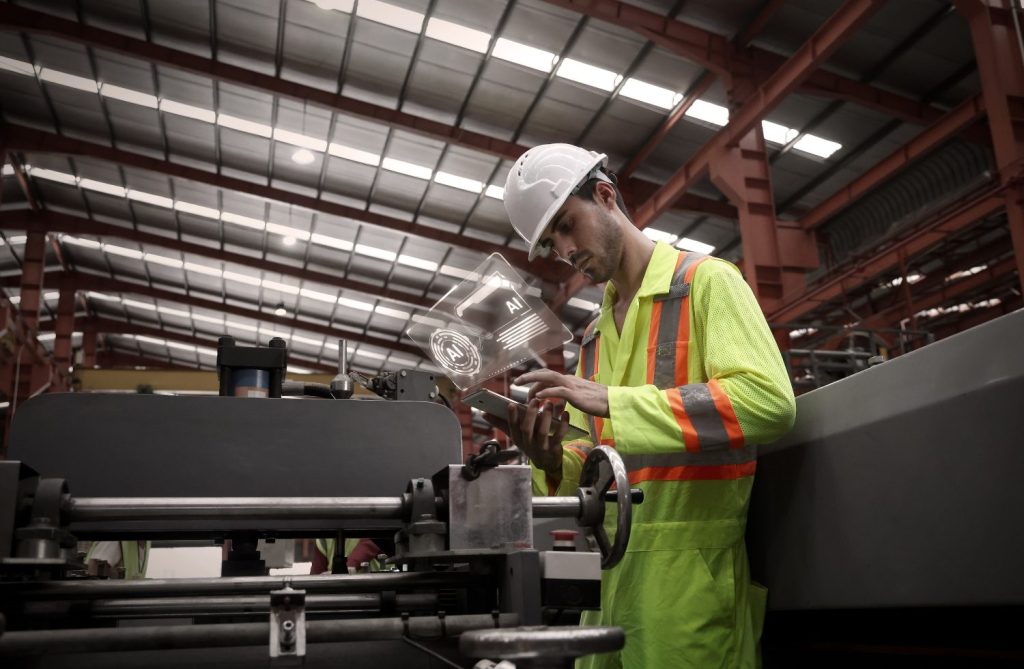
The feasibility of AI technologies in manufacturing seems to no longer be up for debate. Practical applications like predictive maintenance, where maintenance needs are addressed before failures leads to downtime, and smarter scheduling, which optimizes production in real time, have led to a complete perspective shift. Across the manufacturing industry, raising efficiency is now the prerequisite rather than a goal.
The commercial engine is another story. The infrastructure for pricing, quoting, ordering, and customer experience remain largely unchanged and detached from the current AI conversation.
This is the next frontier for transformation, and the pace of development is already faster than that of the factory floor.
To grasp the big picture, this guide explores how B2B manufacturing commerce is being transformed by AI, which implementation challenges currently exist, and what platform foundation is required to truly reap the benefits.
AI in Manufacturing Today: An Overview
AI has become deeply integrated across the entire manufacturing process. Recognizing this is the first step towards anticipating what comes next.
From the Factory Floor to the Front Office
In competitive manufacturing operations, predictive maintenance, computer vision-based inspection, and industrial robotics are now standard practices. AI systems flag equipment degradation, catch defects at line speed, and compress planning cycles.
The AI shift is advancing into both upstream and downstream of production, notably in:
- Engineering workflows: Generative design, simulation, and materials science.
- Commercial systems: Sales, pricing, service, and AI in manufacturing eCommerce.
Despite this, while the manufacturing sector outpaces other industries in production data generation, most of this data has historically remained locked away from the commercial layer, where it could be utilized to drive better outcomes for buyers. Organizations that strategically shift their approach early here can ensure long-term success in manufacturing commerce.
Why Manufacturing eCommerce is Poised for AI Transformation
B2B buyers’ expectations for digital experiences are informed by their perspective as consumers. This means:
- Self-service ordering
- Real-time inventory visibility
- Instant quotes
These demands, however, clash against the actual operations of manufacturing commerce, where static rules cannot solve data problems caused by:
- SKU complexity
- Multi-site pricing inconsistencies
- Variable contract terms
In this context, AI technologies have proven to be more than capable of handling these challenges. Features like machine learning allows for handling account-level pricing complexity at scale, in addition to natural language processing that makes massive catalogs searchable by user intent, as well as predictive models that flag potential reorders before buyers even log in.
By letting AI handle these challenges, teams are freed up to focus on more complex problem-solving that will put them ahead of their competitors.
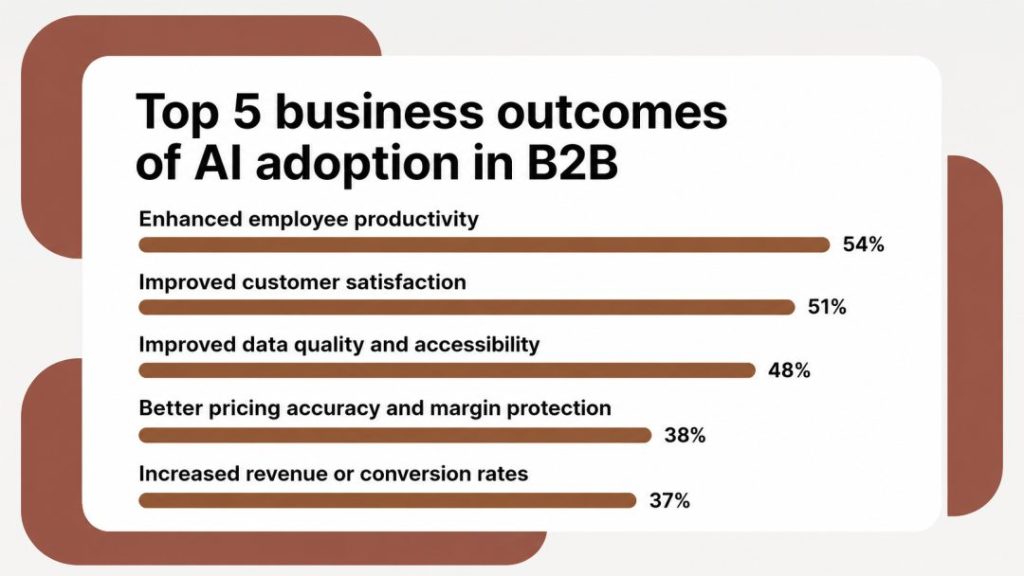
The Core AI Technologies Driving Change
The industry currently employs different types AIs for various functions, each with their own costs, maturity levels, and ROI profiles.
| Type | Best-fit use case | Manufacturing example | eCommerce example | Maturity (2026) |
|---|---|---|---|---|
| Large language models | Content, summarization | Technical documentation | Product description generation | High |
| Industrial small language models (SLMs) | Narrow operational tasks | Defect classification, PO parsing | Search ranking, quote generation | Growing |
| Generative AI | Design, recommendations | Generative part design | Catalog enrichment, personalization | Moderate |
| Edge AI | Real-time, on-machine decisions | Inline quality inspection | Stockout prediction at warehouse | Moderate |
| Digital twins | Simulation and optimization | Plant layout modeling | Demand and inventory simulation | Moderate |
Key B2B Manufacturing Trends Shaping the Future
A truly effective manufacturing digital transformation strategy is one that recognizes that the latest B2B manufacturing trends are not distant forecasts, but already taking place in the here and now. Accordingly, this strategy places these trends at the heart of its activities.
Agentic AI and Autonomous Commerce: Rapid developments in agentic commerce is paving the way for a new phase of the automation revolution. AI agents will increasingly intermediate B2B buying processes, handling tasks such as triaging inbound RFQs, auto-generating draft quotes for representative review, and reconciling purchase orders against contracts.
The important thing for leaders is to differentiate true agentic AI from simple workflow automation by demanding clarity on the decisions the AI makes and the data that trains it.
Generative Design, Digital Twins, and Edge AI: These technologies are reshaping both production and commerce:
- Generative design creates lighter, stronger, and more material-efficient parts, pairing naturally with additive manufacturing.
- Digital twin technology simulates product behavior and supply chain dynamics in real time, allowing for virtual testing before committing physical resources.
- Edge AI moves inference onto machines at the point of production, enabling local, millisecond decision-making for tasks like quality inspection where cloud latency is a barrier.
Industrial AI Replaces General AI: There is a major shift occurring from general-purpose large language models to “industrial AI.” These are smaller models trained on specific mechanical, operational, and transactional manufacturing data.
In manufacturing application, small language models (SLMs) designed for narrow tasks can outperform large general models on cost and latency. This results in AI systems being baked directly into order management, pricing engines, and supplier portals.
How AI Is Reshaping B2B Manufacturing eCommerce

The following use cases are in production at manufacturers today and represent concrete applications of AI in manufacturing eCommerce.
Smarter Product Discovery and Search: Industrial catalogs with complex part numbers and specifications often break traditional keyword search. On the other hand, NLP-powered search understands industrial terminology, maps synonyms, and returns results based on user intent. This allows higher self-service conversion rates and reduces reliance on inside sales for basic lookups.
AI-Powered Quoting, PO Conversion, and Pricing: AI can parse inbound RFQs from unstructured formats like PDFs and emails, converting them into structured data and drafting quotes for review, significantly cutting the time required for the process.
Dynamic pricing models further balance contract terms, inventory levels, and margin targets in real time, making static price lists live signals that provide real insight into supply chain conditions.
Personalization at the Account-Level Scale: Where static rules fail, machine learning can handle B2B personalization complexity like managing multi-user accounts, tiered approval workflows, and contract-specific pricing. This enables customer-specific catalogs, predictive replenishment alerts, and a shared, AI-enriched account view for both sales reps and self-service buyers.
The Real Challenges: AI Washing, ROI, and Governance
AI application in manufacturing is not without its challenges, some of which can be significant and require careful consideration. Below are three typical problems organizations may encounter.
Spotting AI Washing in Vendor Pitches: Many tools marketed as “AI” are merely rules-based automation, which neither improves with data nor delivers compounding returns. This is why before committing to a solution, leaders should ask vendors three specific questions:
- What decision is the AI actually making?
- What data trains the model?
- How is the outcome measured?
If a vendor cannot provide details on these questions, the capability is likely marketing rather than engineering.
Data Readiness Is the Real Blocker: Data quality can positively or negatively affect AI performance. To achieve consistent results, ensure that product data is clean, account hierarchies across systems (ERP, PIM, CRM) are unified, and pricing rules are consistent. The struggle to show clear AI ROI often stems from these foundational data and integration gaps, not the AI technology itself.
Governance, Security, and the Human-in-the-Loop: Each AI integration expands an organization’s attack surface, making a robust governance framework essential. This includes role-based access controls, private model instances that do not expose IP to third-party training, and clear human approval authority on critical decisions like pricing and fulfillment. The ideal perspective for manufacturing AI today is “co-pilot, not auto-pilot.”
| Dimension | Question to ask | Typical gap | Fix |
|---|---|---|---|
| Data | Is product, account, and pricing data clean and unified? | Fragmented across ERP, PIM, CRM | Unify into a single commerce data model |
| Integration | Do systems share data without reconciliation? | Point-to-point integrations that break | API-first architecture with native connectors |
| Governance | Are access controls, audit trails, and model policies defined? | No AI governance framework | Define before deployment, not after |
| Talent | Do teams know how to act on AI outputs? | AI treated as a black box | Train on AI reasoning and output validation |
| Vendor evaluation | Can the vendor explain the AI’s decision logic? | Vague answers about “proprietary models” | Require specifics on training data and measurement |
| Change management | Do frontline teams trust AI recommendations? | Skepticism from experienced staff | Start with validated wins and visible reasoning |
Building the Foundation: An AI-Ready eCommerce Stack
The right platform foundation can decide whether AI gives manufacturers the competitive edge needed or remains stuck as a series of disconnected experiments.
Unify Commerce and Operational Data
AI performs best when commerce, CRM, pricing, and inventory systems share a single source of truth. A unified commerce platform built on a single data model removes the need for middleware and data reconciliation, supplying AI models the clean, consistent inputs they require.
| Capability | Retail-first platforms | Unified B2B Platform |
|---|---|---|
| Account hierarchy | Limited, add-on required | Native, multi-level |
| Contract pricing | Basic, rules-limited | Advanced, per-account |
| Native CRM | Separate tool | Built-in |
| Native B2B AI | Not available | Included |
| ERP integrations | Generic API only | Pre-built connectors (e.g., SAP, Dynamics, NetSuite) |
| Deployment flexibility | SaaS only | Cloud, private cloud, on-premise |
| Per-site fees | Yes | No |
Prioritize Integration-First Architecture
The software applications manufacturers rely on must be able to share data in real time. An API-first, headless-ready architecture allows new AI services can plug into existing workflows without requiring a complete re-platforming effort.
Key Takeaway: The Right Platform Foundation for an AI-driven Future in Manufacturing
To fully harness the benefits of AI adoption in the industry, manufacturers must decide on a solid, specially-built B2B platform that forms the robust data foundation for business operations.
OroCommerce presents itself as the ideal choice. A unified B2B eCommerce software aimed towards manufacturers from the outset, it brings together eCommerce, CRM, CPQ, CMS, PIM, DAM, invoicing, and payments under just one license.
An OroCommerce platform runs on a single data model that ensures account, product, and pricing data are consistent across every workflow. This bypasses any concern about reconciliation step, data sync delay or version mismatch, providing an edge over assembled stacks.
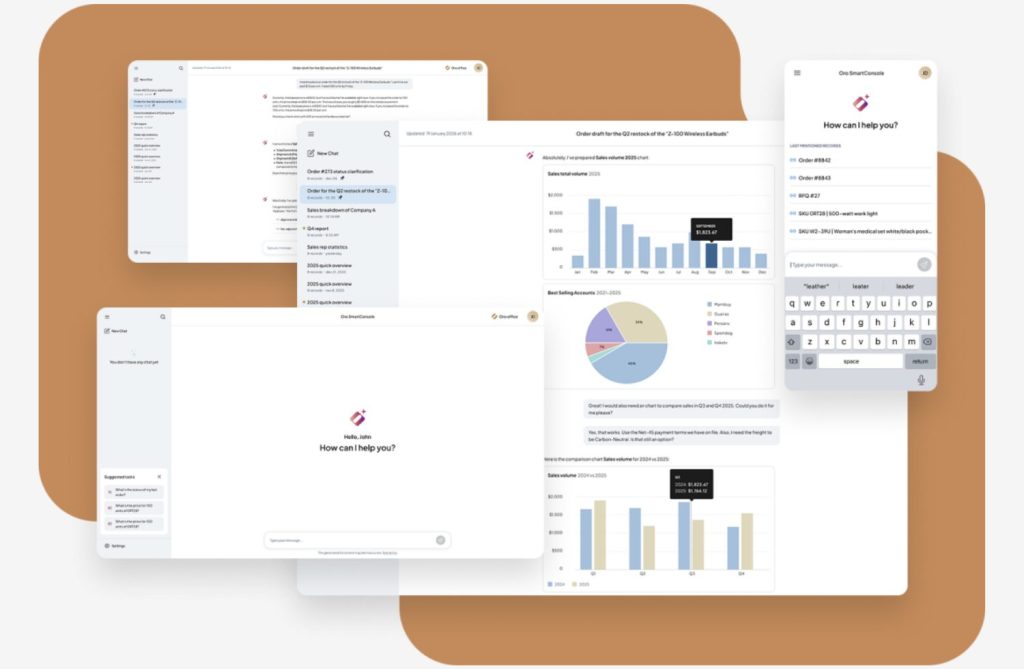
In addition, OroCommerce includes a native AI layer called OroIQ that is already integrated into the same database as pricing rules, account hierarchies, and contract terms. OroIQ has several live AI-powered tools to effectively support business operations:
SmartOrder: Automates inbound PO processing, including parsing documents, matching line items to catalog entries, flagging exceptions, and routing for approval.
SmartAgent: Lets buyers and sales reps query commerce data in natural language, getting answers on order status, account history, and product availability.
SmartInsights: Lets managers query business data in plain English and get charts, KPIs, and tables on demand, no custom report configuration required.
SmartAssistant: Equips internal sales teams with a back-office copilot for creating quotes, building customer segments, and pulling account data by typing a plain-language request.
These functions are shipped under the same standard license, allowing companies to take advantage of OroCommerce across multiple portals, brands, or regional operations without additional site-based or usage-based fees.
| Capability | Retail-first platforms | OroCommerce |
|---|---|---|
| Account hierarchy | Limited, add-on required | Native, multi-level |
| Contract pricing | Basic, rules-limited | Advanced, per-account |
| Native CRM | Separate tool | Built-in |
| Native B2B AI (OroIQ) | Not available | Included in license |
| ERP integrations | Generic API only | Pre-built connectors (SAP, Dynamics, NetSuite) |
| Deployment flexibility | SaaS only | OroCloud, private cloud, on-premise |
| Per-site fees | Yes | No |
The greatest AI payoff in manufacturing will increasingly come from commercial applications, through practical applications like faster quoting, smarter supply chains, and personalized buyer experiences. Adopting AI first does not automatically mean staying competitive, but manufacturers that operate on a platform foundation designed for the evolving landscape of AI in manufacturing eCommerce can guarantee their continued edge in the market.
Ultimately, the dividing line between short-term gains and sustainable, long-term success in AI adoption depends on treating platform strategy and AI strategy as the same decision.