




OroCommerce 7.0: Key Innovations for Manufacturers and Distributors in 2026
Since 2017, OroCommerce has positioned itself as the go-to solution for enterprise B2B in managing operational complexities, effectively addressing problems such as tool sprawl: many organizations suffer not from a lack of options, but instead an overabundance of new tools, integrations, and emerging capability. Plus, as AI becomes an active agent of change, it can either promise transformation, or simply add another layer of technical debt before the foundation is even stable.
In fulfilling clients’ need for a single, solid base of operation in order to maximize the return on AI, OroCommerce has developed from a simple online catalog to a unified B2B e-commerce platform layer that links inventory, orders, quotes, returns, invoicing, and payments into one intelligible flow. AI stops being an obstacle and becomes a jumping-off point for organizations to effectively grow and expand at unprecedented momentum.
With the latest release of OroCommerce 7.0, we’re refining this platform even further.
Rather than adding complexity, this release focuses on reducing it by strengthening the platform’s core capabilities across three strategic dimensions: enterprise-grade infrastructure, unified commerce operations, and practical AI implementation. The 7.0 version provides comprehensive support for the B2B process in security and speed, with an eye towards future growth and scale.
1. Enterprise-Grade Infrastructure: Scaling with Operational Demands
Streamlined Identity Management
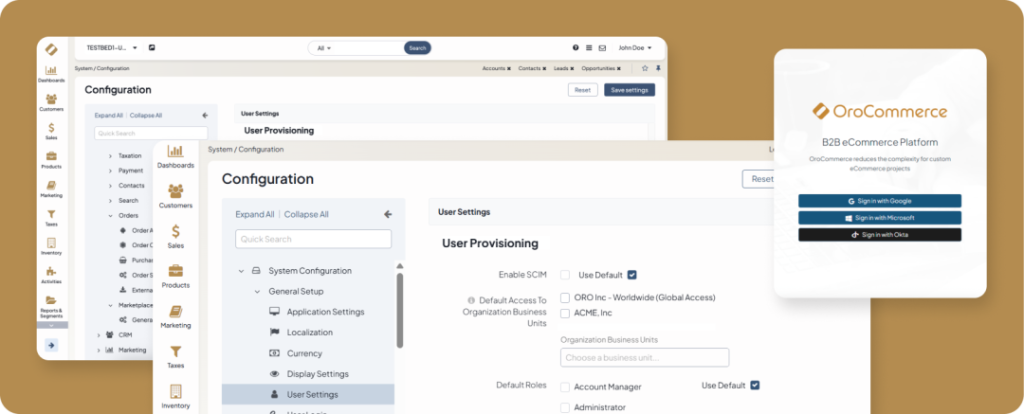
For organizations operating across multiple regions, business units, or customer segments, identity management and access control are non-negotiable requirements. Manual processes like adding and removing accounts by hand are inefficient, prone to security risks, and too often lead to operational deadlocks between leadership and teams in charge.
OroCommerce 7.0 now introduces native support for enterprise identity provisioning, eliminating manual account management processes that create security gaps and compliance risks. This comes in three key integrations:
- The platform integrates directly with identity providers through OpenID Connect (OIDC), enabling single sign-on with solutions such as Okta and Microsoft Entra.
- SCIM integration automates user provisioning and deprovisioning across the organization’s identity infrastructure.
- For enterprises with strict security policies, SSO-only enforcement allows IT teams to mandate authentication exclusively through approved identity providers for designated domains or user groups.
With this improved identity and access control support, teams can work better, faster, and with greater confidence in the system.
Efficient and Stable Commerce Management
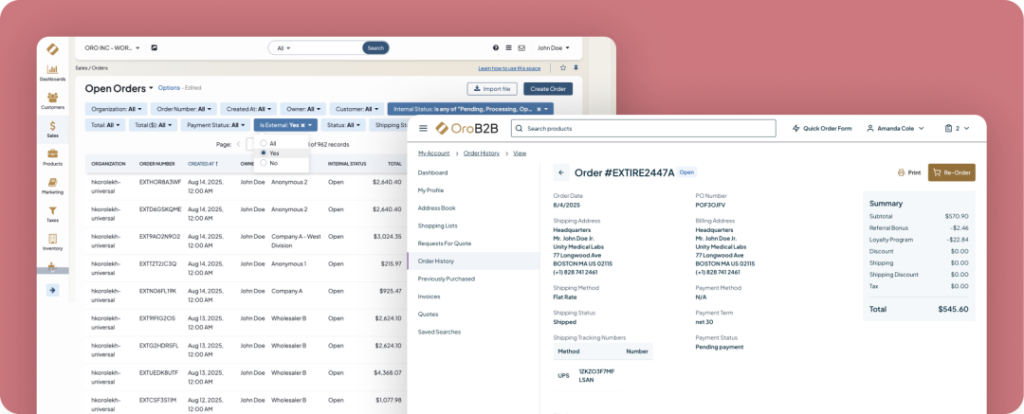
Aside from identity, the release focuses on the operational realities of managing commerce at scale. As data accuracy becomes vital, exchange rates fluctuate, and volumes of orders pile in, OroCommerce 7.0 offers a range of capabilities to address these challenges head on:
- Multi-currency price rules now reference system exchange rates directly in pricing formulas, automating adjustments as rates fluctuate across global markets.
- Advanced product import capabilities support category matching by ID or full path, improving catalog accuracy in complex hierarchies.
- External order import functionality accepts historical or ERP-generated orders in JSON format, preserving legacy data integrity while providing buyers with unified order histories.
The 7.0 version also includes advanced API Search, with new filters to facilitate more flexible and precise search capabilities in the Back Office API, bringing it closer to UI-level search functionality while also enabling powerful integration. This is complemented by the Organization Selector upgrade, which implements lazy-loading and auto-complete functionality that enhance usability and performance for multi-organization environments with ten or more organizations.
These new functions let organizations move away from manual handling towards more consistent management of scale and complexity, as their architecture expands and becomes increasingly sophisticated.
Built for Speed and Security
OroCommerce’s support for platform modernization extends to security, a crucial element for any organization looking to expand without creating new problems for its security, speed, or architectural integrity. In particular, this enhanced security goes hand-in-hand with improved site performance for both front-end users and back-end developers. This begins with support for Symfony7, strengthening performance while empowering developers by upgrading the codebase and introducing new capabilities.
- For security, enhancements include Subresource Integrity (SRI) to verify frontend asset authenticity like JavaScript and CSS files, which lowers the risks coming from CDNs and third party assets.
- For performance, OroCommerce 7.0 enables asset preloading to improve page rendering speed and SEO performance. Similarly, administrators have closer supervision over the presented public content, by displaying specific storefront pages to users without requiring custom work.
By balancing both these aspects, OroCommerce ensures a digital foundation that is as resilient as it is responsive, geared towards long-term growth and expansion.
2. Unified Commerce Operations: A B2B e-commerce Platform for Quote-to-Cash Operations
One Whole Process, in One Place
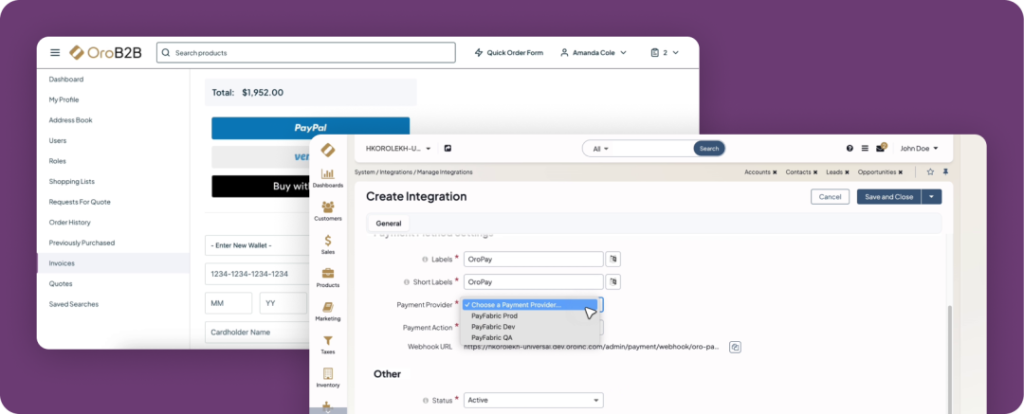
When data and payments are fragmented across systems, this creates operational friction, particularly in high-touch B2B sales environments where quotes, invoices, and payments span multiple platforms. OroCommerce 7.0 consolidates these processes into a single commerce layer, reducing integration overhead and improving financial visibility. This version introduces a number of new functionalities and upgrades:
- OroPay, a native B2B payment solution developed with Global Payments, brings enterprise-grade payment processing directly into the platform. It supports Level 2 and Level 3 credit card transactions along with ACH payments, designed specifically for B2B compliance requirements.
- Buyers can now view, track, and pay invoices directly from the storefront using OroPay or Stripe Elements. This results in a clearer post-purchase payment process.
- Back-office teams gain full invoice lifecycle management capabilities within OroCommerce, with API support for ERP synchronization and custom payment workflows.
- Additionally, the expanded invoice APIs enable both custom payment statuses and external payment links, leading to tighter ERP integration and control over complex payment flows for teams. The payment process becomes more flexible without the risk of security gaps.
With these capabilities, the entire quote-to-cash cycle can be executed in OroCommerce, significantly simplifying the process while guaranteeing operational speed and transparency.
Reinforced Buyer-Seller Partnership
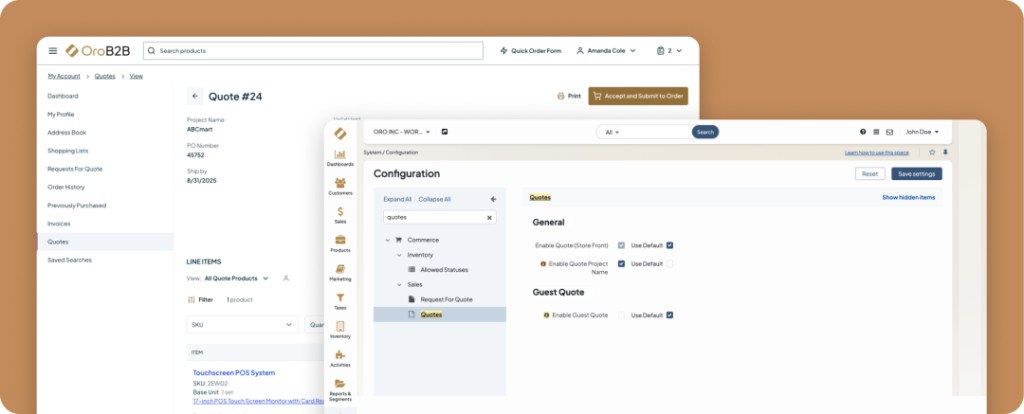
OroCommerce 7.0 strengthens the links between buyers and sales teams in several significant ways, most notably by enhancing negotiations, tracking, and collaboration:
- Improved requests for quotes (RFQs) and quote linkage provides clearer visibility throughout negotiation cycles.
- A new project name field allows customers, especially B2B buyers like contractors managing bill-of-materials (BOMs) workflows, to organize quotes by initiative, whether it is grouping, searching, or managing related quotes.
- Sales teams can attach contracts and specification documents directly to quotes or orders, with storefront access for buyers.
- A new back-office quote API enables external CRM or field sales tools to create and manage quotes programmatically, streamlining multi-system sales workflows.
In B2B sales, where frequent and personalized contacts between both sides are central, the 7.0 version ensures greater visibility and coordination from the first RFQ until the final approved quote.
Built for B2B Business
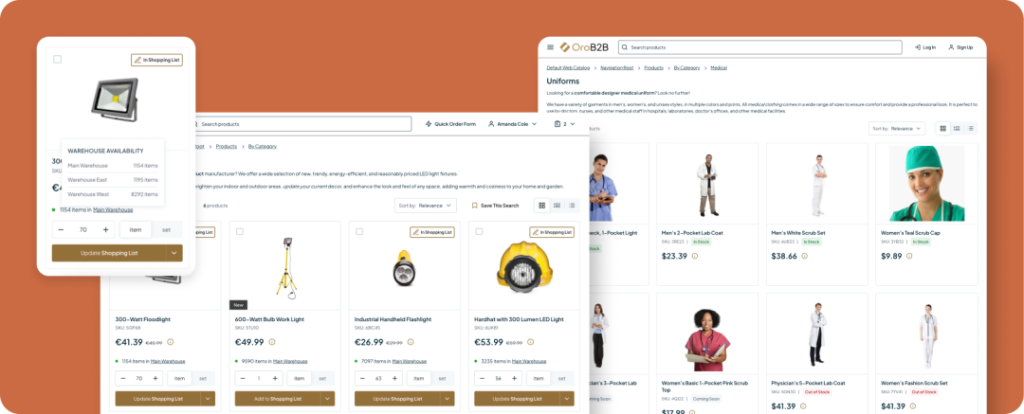
OroCommerce 7.0’s enhanced capabilities are built to effectively respond to the realities of B2B transactions, which exceed that of retail shopping: complex order cycles, recurring procurement schedules, and multi‑level approval processes. The OroCommerce-powered storefront introduces several buyer-focused capabilities to empower procurement teams:
- Recurring orders enable automated replenishment schedules with configurable frequency, start and end dates, and active status controls to pause, resume, or cancel. Scheduling and visibility are guaranteed to be visible.
- Real-time inventory visibility displays stock levels across product pages, search results, and checkout, with support for per-location stock and low-stock alerts for better planning.
- When items become unavailable during checkout, the system automatically moves them to a “Save for Later” section, allowing buyers to complete current orders without disruption. They can reorder the products later once stock returns.
- Administrators have greater control over page visibility, with the ability to configure which storefront pages are visible. More sensitive content like product and pricing data, as well as customer-specific information are available only to authenticated users.
- Fully formatted order PDF downloads provide buyers a means to verify their orders either directly from the storefront or as an email attachment. The PDF’s layout conforms to company branding and allows custom metadata fields or document templates.
- Procurement teams can better track and report buyer activities through a new dashboard widget, which provides a unified view into key activity summaries, current RFQs and shopping lists, as well as total orders.
With these enhancements, the OroCommerce storefront now runs as a central hub for B2B operations. Buyers are empowered to deftly plan, order, and oversee purchases at enterprise scale.
3. Practical AI Implementation: Infrastructure and Features
AI Infrastructure with Controlled Governance
The deployment of AI in enterprise environments, especially in B2B business where it is playing an increasingly prominent role, requires both flexibility for experimentation and governance to ensure reliability and security. OroCommerce 7.0 features a dedicated AI infrastructure layer that simultaneously connects external AI services and maintains control over data access and model behavior. More specifically:
- The platform’s AI integration layer includes support for Model Context Protocol (MCP) servers, establishing a secure architecture for integrating custom or third-party large language models.
- For consistency and traceability, Langfuse prompt management centralizes versioning, testing, and updating of AI prompts used across OroCommerce’s suite of AI tools.
- (In the event the prompt management service becomes unavailable, a resilient fallback mechanism maintains AI feature availability, automatically reverting to cached or code-based prompts.) These built-in AI features are transitioning to the Google Gemini model family, delivering improved response times and accuracy.
AI Features for Direct B2B Workflow Upgrades
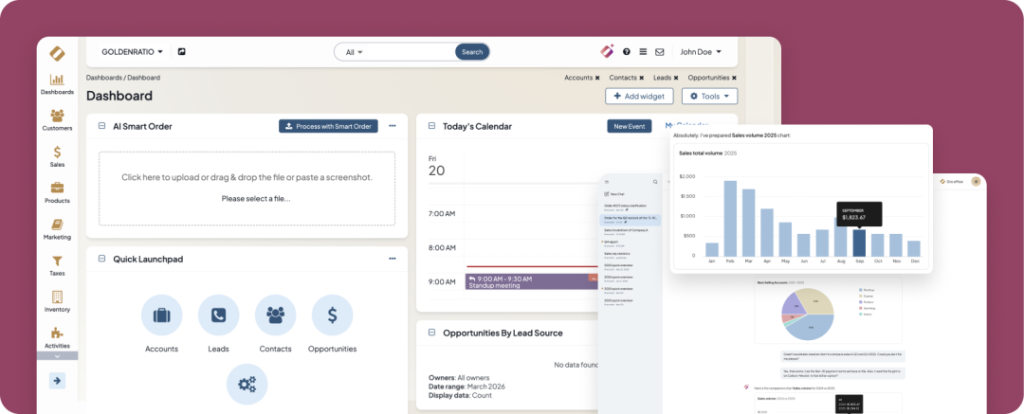
For B2B teams, the OroCommerce-powered platform’s approach to AI commerce prioritizes practical applications over experimental features, focusing on capabilities that integrate naturally into existing workflows. This means upgrades to existing features along with new capabilities:
- The improved SmartOrder now recognizes Customer Product Numbers (CPNs) in uploaded purchase orders, mapping customer-specific identifiers to internal SKUs with enhanced AI-powered extraction accuracy for both digital and scanned documents.
- SmartInsights functions as an AI-driven analytics co-pilot that lets users explore business data using natural language queries, while respecting role-based permissions and data governance policies.
- SmartAssistant is another AI co-pilot that automates routine tasks such as creating sales orders, quotes, or shopping lists, and can act on insights like identifying buyers who haven’t ordered in six months and adding them to a new segment. By automating multi-step processes within OroCommerce, SmartAssistant significantly cuts down manual tasks and potential errors, while accelerating crucial flows like quote-to-order.
Finally, for internal teams like sales and service, OroIQ is the back-office AI orchestrator that provides a unified conversational interface that connects all AI-powered tools within OroCommerce. Users can query data, execute tasks, and access features like SmartAssistant and SmartInsights through a single natural-language console.
OroCommerce 7.0’s AI-powered features integrate directly into current B2B workflows, bringing quantifiable improvements in accuracy, efficiency, and ROI. Third-party custom integrations are no longer required, keeping your proprietary data secured.
NOTE: AI features like SmartOrder, AI-powered search, and content generation are included in the OroCommerce Enterprise license without additional cost, while early participants also receive AI token costs for OroIQ (in customer beta) with the license at no charge. If enabled, Product Recommendations incurs Google Vertex AI usage fees based on volume and training time, though the OroCommerce extension itself remains free with administrator-controlled training cadence.
What’s Next: Strategic Considerations for Enterprise Decision-Makers
In evaluating platforms for digital transformation initiatives, OroCommerce 7.0 represents a consolidation strategy rather than one geared for expansion. The release addresses a fundamental tension in enterprise technology: the need to adopt new capabilities without compounding integration complexity.
With the 7.0 version release,
- The identity provisioning capabilities reduce IT overhead while strengthening security posture.
- The unified quote-to-cash operations reduce the number of systems involved in revenue-generating processes.
- The AI infrastructure provides a governed environment for experimentation without requiring exposure of proprietary data to third-party services through custom integrations.
These transformations are geared towards reducing total cost of ownership while increasing operational capability. In this way, the 7.0 version takes these existing capacities one step further.
To address scale, efficiency, and future growth, OroCommerce has provided a unified technical foundation that empowers owners while integrating AI towards realistic gains. Organizations gain a single, powerful base to continue business operations with confidence and ease, while being prepared for a future of potential new revenues and game-changing technologies transforming the B2B sector.
OroCommerce 7.0 is a new milestone, and it won’t be the last.
Interested in experiencing OroCommerce 7.0’s capabilities for yourself? Contact us now via contact@ekino.vn for a demo of the latest version.