




Enterprise B2B eCommerce: The Definitive Strategic Guide (2026)
In the current landscape, Enterprise B2B eCommerce is no longer defined simply by online transactions. It is the sophisticated orchestration of digital buying and selling between large-scale organizations, powered by platforms engineered to manage contract-negotiated pricing, multi-stakeholder approval hierarchies, and deep architectural integrations at scale.
With US B2B eCommerce projected to surpass $3 trillion by 2027, the window for digital transformation is narrowing. Market leaders are proactively investing in a robust ERP-Integrated E-commerce infrastructure to capture this growth, rather than reacting to it.
The Paradigm Shift in Procurement Expectations
The professional procurement landscape has undergone a generational shift. Millennial and Gen Z professionals now dominate B2B buying teams, bringing with them a “consumerized” expectation for digital interactions. They demand:
- Self-Service B2B Portal: Real-time access to account-specific pricing and inventory 24/7.
- Frictionless Configuration: The ability to customize complex orders via Agentic AI Procurement tools that automate workflows.
- Omnichannel B2B Experience: A consistent journey across mobile apps, web portals, and sales-rep interactions.
Traditional infrastructures often fail these users. Many legacy systems were originally built for B2C retail, with B2B features “bolted on” as an afterthought. These compromises quickly fracture when faced with the realities of volume-based pricing, complex ERP dependencies, and multi-tier approval workflows.
Defining Enterprise-Grade B2B eCommerce
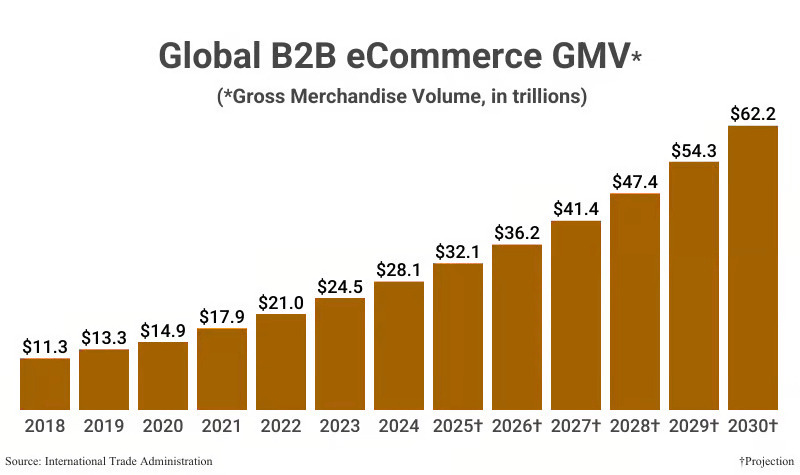
source: Capital One Shopping: https://capitaloneshopping.com/research/b2b-ecommerce-statistics/
“Enterprise” refers to a specific level of operational complexity. While a standard webstore might handle a simple wholesale list, an enterprise environment manages thousands of SKUs, intricate account hierarchies, and Account-Based Personalization that serves distinct buyer needs across global regions.
Critical Differentiators: B2B vs. B2C
Unlike retail models, enterprise B2B commerce requires native support for:
- Extended Sales Cycles: Involving multiple stakeholders and “buying committees.”
- Financial Workflows: Utilizing Purchase Orders (POs) and net terms rather than simple credit card transactions.
- Contractual Pricing: Prices are negotiated per account or tier, not displayed uniformly.
- Organizational Mirroring: The platform must reflect the buyer’s internal approval structure through a dedicated Self-Service B2B Portal.
Why Adaptation Fails (B2C Platforms & ERPs)
Many enterprises attempt to digitize by repurposing existing tools, but these “path of least resistance” strategies often lead to technical debt and fractured buyer experiences.
The B2C Adaptation Trap
Consumer-first platforms (like Shopify or Magento) are excellent for retail, but they lack a native B2B core. Their architecture assumes a “one-to-one” relationship, which struggles with the “many-to-many” complexity of enterprise accounts. To achieve Account-Based Personalization, businesses must rely on third-party plugins, creating a “brittle” environment where updates can break essential workflows.
The ERP Overextension
Attempting to use an ERP as a storefront is a common pitfall. While ERP-Integrated E-commerce is essential, the ERP is a back-office engine, not a customer-facing tool. They typically offer rigid interfaces that fail to provide the intuitive experience modern procurement teams demand, often leading to performance bottlenecks during peak periods.
Neither path provides the Omnichannel B2B agility required to stay competitive. A purpose-built platform is required to bridge the gap between back-office logic and front-end buyer expectations.
Comparison: Mid-Market vs. Enterprise B2B Platforms
| Capability | SMB/Mid-Market Platform | Enterprise B2B Platform |
|---|---|---|
| Account structure | Single-level accounts | Multi-tier hierarchy (parent/child/cost center) |
| Pricing model | Fixed or simple tiered | Per-account contract pricing + volume rules |
| ERP integration | Batch sync via middleware | ERP-Integrated E-commerce (Real-time) |
| Checkout | Standard consumer flow | PO numbers, net terms, approval routing |
| Catalog management | One catalog for all buyers | Account-Based Personalization & Role-gated catalogs |
| Sales Channels | Single storefront | Omnichannel B2B (Web, Mobile, Marketplace), Multi-site, multi-brand, multi-region |
| RFQ / CPQ | Third-party plugins | Native / Built-in |
Sector-Specific Requirements

Wholesalers
For wholesalers, the challenge lies in managing a vast buyer base with unique negotiated terms. Self-service portals are essential to offload work from sales teams and provide buyers with 24/7 visibility into their specific contract rates.
Manufacturers
Manufacturers require Product Configurators (CPQ) capable of handling complex Bill-of-Materials (BOM) logic. They also need seamless dealer portals that pull real-time lead times and inventory data directly from the ERP.
Distributors
Operating with SKU counts often exceeding 100,000, distributors need high-performance search and real-time inventory visibility across multiple warehouse locations. They also require “Order on Behalf” features for sales reps to assist high-value accounts.
Essential Features for Enterprise Success
An B2B commerce enterprise platform must excel in these six pillars:
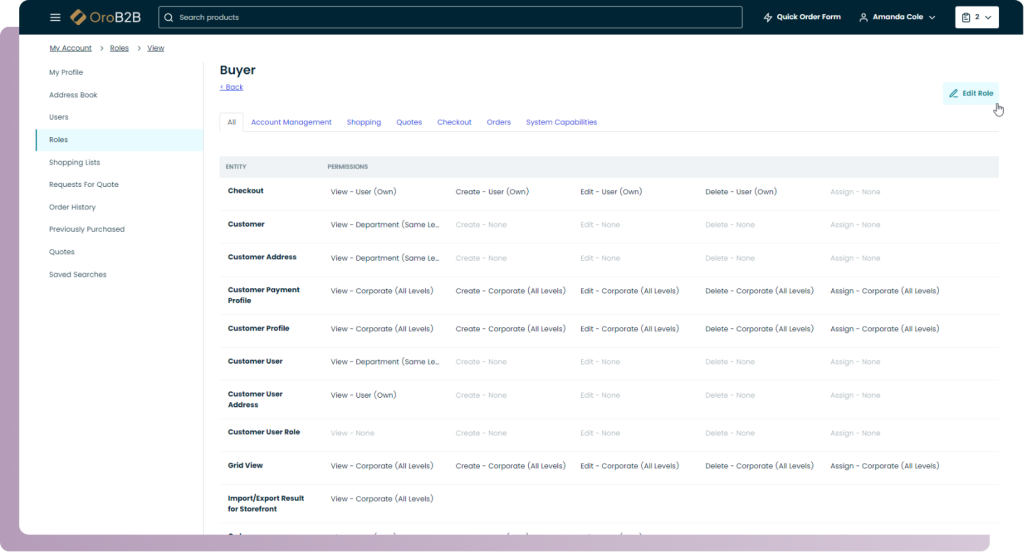
1. Advanced Account & Hierarchy Management
The platform must natively reflect the buyer’s organization. This includes role-based permissions (Buyer, Approver, Admin) and the ability to set budget limits at the department or cost-center level within the Self-Service B2B Portal.
2. Intelligent Pricing & Quoting
Dynamic pricing is a core requirement. The engine must support:
- Quantity Breaks: Automatic discounts based on volume.
- Quote-to-Order Workflows: Transitioning a negotiated RFQ into a live order without data re-entry.
3. Agentic AI Procurement
Modern platforms now leverage Agentic AI Procurement to assist buyers. These AI agents can analyze past purchasing patterns, recommend optimal stock levels, and handle routine re-orders or invoice reconciliations autonomously, significantly reducing the buyer’s manual workload.
4. Account-Based Personalization
“Right product, right buyer.” Use role-gated visibility to ensure customers only see the products relevant to their specific contract or region.
5. Headless & Composable Architecture
An API-first approach ensures the platform can adapt to future technologies, such as mobile apps, marketplaces, or AI-driven agentic commerce, without requiring a total re-architecture.
6.Omnichannel B2B Synchronization
Whether a buyer places an order through a portal, a mobile app, or a field sales representative, the data must be unified. Omnichannel B2B capabilities ensure that inventory, order status, and credit limits are accurate across every touchpoint.
Strategy: Evaluating Enterprise Vendors

When selecting a partner, look beyond the demo. Focus on Total Cost of Ownership (TCO) and architectural integrity.
Critical Questions for Stakeholders:
- B2B Native? Was this platform built for B2B from day one, or is it a modified retail tool?
- ERP Provenance? Can the vendor show live integrations with your specific ERP (e.g., Sage X3, Microsoft Dynamics, Epicor, SAP)?
- Scalability? What is the largest SKU count and transaction volume currently running on their production environment?
Red Flag: Avoid vendors with transaction-based pricing models, as these effectively penalize your business for growing and scaling.
Why OroCommerce for Enterprise B2B?
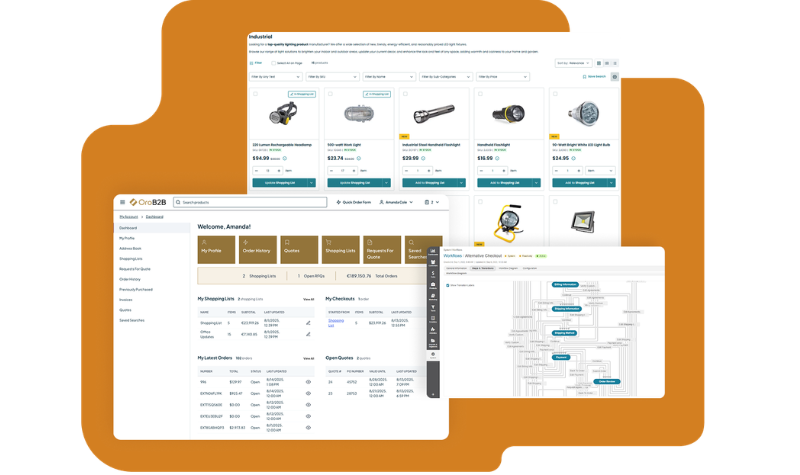
OroCommerce was engineered specifically to solve the structural gaps in B2B commerce. It provides a unified solution that eliminates the need for “Frankenstein” tech stacks.
- Native CRM Integration: Unify customer data across sales reps and digital storefronts.
- AI SmartOrder & SmartAgent: Leverage Agentic AI Procurement capabilities to convert emailed PDFs into digital orders and provide account-aware AI support agents.
- Visual Workflow Engine: Customize approval and quoting flows to match your unique business logic without heavy coding.
- Global Readiness: Support for multi-organization, multi-currency, and multi-language deployments from a single backend.
- Scalable Personalization: Deliver deep Account-Based Personalization across thousands of SKUs and unique customer segments.
Conclusion
In 2026, the choice of a B2B eCommerce platform is a high-stakes strategic decision. Moving toward a unified, B2B-first architecture reduces manual overhead, satisfies the demands of modern buyers, and ensures your infrastructure is an engine for growth rather than a bottleneck.
Navigate Your Digital Transformation with Ekino Vietnam
Implementing a large-scale B2B eCommerce system involves complex challenges—from deep ERP integrations to orchestrating intricate business workflows. At Ekino Vietnam, we go beyond technical execution; we serve as your strategic partner to help you harness the full potential of OroCommerce within the local and global landscape.
Whether you are in the early stages of defining your digital roadmap or looking to optimize an existing system, contact us via email contact@ekino.vn ,our team of experts is ready to share practical insights and tailor a solution to your specific operational needs.