







Roles & Permissions Deep Dive for B2B2X Models
When an organization makes the leap towards becoming a genuine B2B2X business, the first, immediate architectural challenge for its commerce platform is access control. The “X” includes direct customers, distributors, dealers, franchisees, and marketplace vendors, who all need to use the platform for different functions, even though they all have some similar business capabilities.
In concrete terms, for example, a distributor wants to manage its buyer and order data without seeing another distributor’s commercial terms or the manufacturer’s internal financial data. The issue of B2B roles and permissions here becomes complicated; from simply restricting back-office entry to making sure boundaries are maintained between various partners working on the same platform.
On the organization side, simply asking “What roles are needed?” doesn’t cut it. Designing a more sophisticated access provisioning model requires accounting for many more considerations, including:
- What the scope of each role is,
- Which resources it can affect,
- And how that scope behaves across different organizations, business units, websites, and workflows.
The correct design decisions strengthens the B2B2X model’s security and operational posture. Otherwise, it becomes entangled in exceptions, manual workarounds, or even mismanaged access that makes partners’ sensitive data and operations visible to all.
This article offers practical pointers into how roles and permissions in B2B2X can be rationalized and improved, to ensure that your new business model is scalable and fully equipped for a variety of users and business contexts.
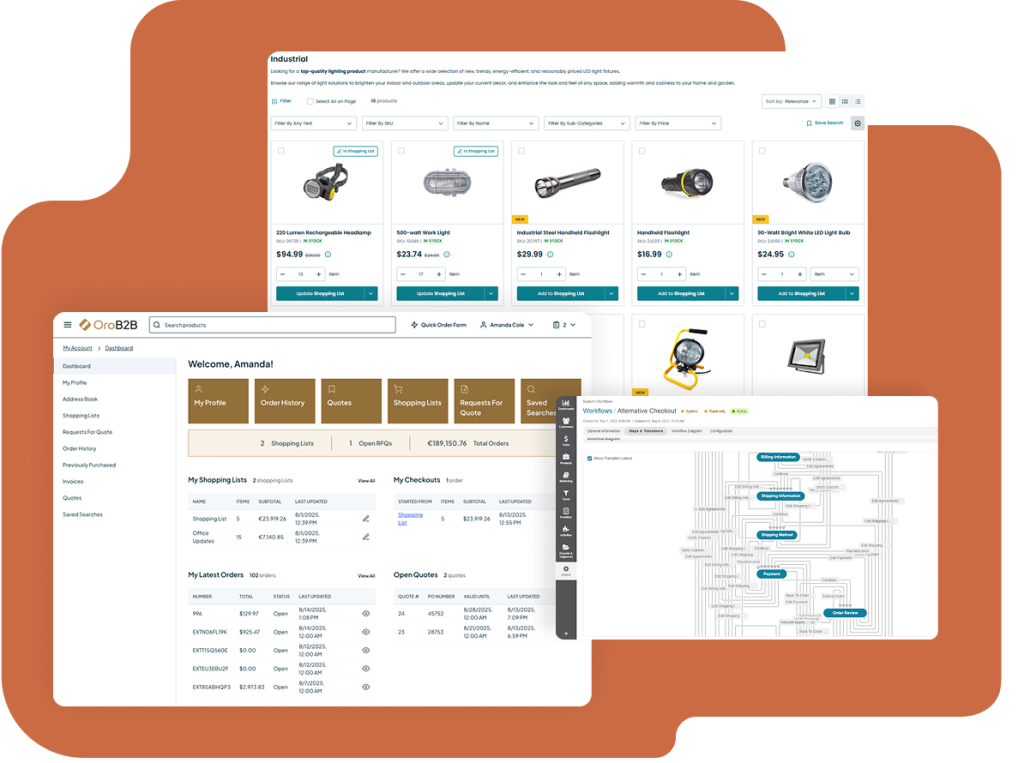
Supporting a B2B2X business model also requires a robust platform with built-in access management intelligence that can respond to the model’s complexities. This is where OroCommerce distinguishes itself from other competitors, which will be explored later.
1. Start with business structure, not job titles
A typical, intuitive starting point for access design are job titles like the buyer, sales representative, or account administrator. Designing roles solely based on familiar job titles, however, ignores the reality of B2B operations where one title takes on multiple responsibilities across different companies, or one user holding many positions across business units.
For this reason, the organizational model offers a more reliable foundation. Map the parties involved in a transaction and the relationships among them, from the platform operator and supplier to the customer company and their branches or departments. Afterwards, identify which data belongs to which party and which operations cross organizational boundaries.
This distinction matters in B2B2X environments, where different kinds of business relationships need to be supported. A marketplace vendor wants to manage its own products and orders, while a parent company requires visibility into its subsidiaries but still allowing each to control its local purchasing activity. These processes go beyond the straightforward supplier-to-customer path.
A refined permission model should reflect these relationships in the platform’s operations. When access design falls into the trap of flattening them to fit one undifferentiated customer account, the burden of role separation shifts from the system to your team instead, who now has to devote energy towards custom code or manual controls.
2. Model permissions across actions, resources, and scope
Labels like “administrator” or “buyer” are a poor indicator of action and permission scope. Building on the principle of making explicit any intended boundary, access provisioning design can instead be structured around 3 interconnected, more specific dimensions:
- The action a user can take, like viewing, creating, editing, assigning, sharing, deleting, or approving.
- The resource or data the action applies to, including customer records, orders, quotes, product catalogs, price lists, invoices, or workflow tasks.
- The scope within which it is allowed, including a user’s own records, a customer account, a branch, a business unit, a website, or a broader organization.
In practice, a user is allowed to create orders for one branch but not view other branches’ orders. A customer administrator can manage users within their company, but a parent-account manager has visibility across different subsidiaries.
These exact permission combinations need to be based on the organization’s policies and its platform’s capabilities. Whether a given user’s authority applies to one single account, a specific site, or an entire customer hierarchy has to be defined and tested using granular criteria, rather than deferring to familiar yet vague role names.
3. Treat approvals as workflow, not just access
In B2B commerce, permissions frequently intersect with multi-step business processes. A buyer can create a cart or request a quote, while a manager is responsible for authorizing a purchase. Before an account is enabled, an internal team has to review the customer onboarding request. These processes should be seen transitions within one workflow, not separate screens for different users.
This matters when designing approvals, since access control only decides whether a user can perform an action in a given context. On the other hand, workflow logic establishes when an action is available, what must happen before it, and where the process goes next. A user has the authority to approve a request, but only when it meets the organization’s rules and is in the correct state.
Document the process separately from the role matrix, then connect them by identifying each step, eligible actors, progression conditions, and the records each actor can view or change. This helps avoid a common design problem: making roles a substitute for business logic.
If requests from a customer group must follow a defined review path, represent that path explicitly rather than relying on informal rules. Workflow configuration also needs to avoid granting actors broader data access than they need to complete their assigned steps.
4. Separate shared capabilities from isolated data
A B2B2X platform has to support shared products, common processes, and centrally managed rules while keeping some data specific to a customer, vendor, brand, or business unit.
Often, a parent company wants to review its activity across branches while keeping their budgets distinct. A marketplace operator provides common order-processing capabilities without allowing one vendor to see another vendor’s records. In these cases, the boundary between shared and isolated data becomes a crucial design decision.
They also illustrate why B2B roles and permissions needs to be designed in tandem with the data model and account hierarchy. If permissions are planned only after entities and relationships are established, the team may discover that the data model does not support the required boundaries cleanly. If the data model is designed without considering access, the platform risks exposing information across organizational lines or force complex workarounds.
Multi-entity and multi-site requirements add another dimension. A global organization may need centrally managed product information alongside local differences in catalogs, currencies, taxes, or inventory. Whether a specific implementation uses one shared instance or another topology depends on its requirements, but the architecture should make clear which data and policies are global and which are local.
5. Design for both customer users and internal teams
A consistent permission model accounts for both internal and external users. Sales, customer service, and operations teams need access to business information to support transactions. Buyers and customer administrators need tools to manage their own purchasing activities. In a B2B setting, those groups may work with the same accounts, quotes, orders, or catalogs, but their responsibilities differ.
Customer-managed roles can reduce administrative dependency on the supplier’s support team, provided the customer administrator’s authority is appropriately bounded. For example, a customer may be able to invite colleagues or assign buying and approval responsibilities within its own account. This, however, does not mean authority to change platform-wide policies or access other customers’ data.
Internal roles also need careful scoping. A sales representative can work with a defined set of accounts, while a service team often needs access to order status and invoice information to respond to enquiries. The key is to decide which controls can be reused across these audiences and which need separate policies.
Consistency isn’t rigidly making every user to follow the same rules. It means that the platform should express the rules through a coherent model, so that access decisions are understandable and governable without being scattered across unrelated customizations.
6. Account for integrations and system boundaries
Commerce permissions do not exist in isolation. B2B platforms commonly exchange data with ERP, CRM, and other business systems. These integrations often carry customer accounts, pricing, inventory, invoices, or order information. When designing access, identify which system owns each relevant record and how user identity, organizational scope, and workflow state are preserved across system boundaries.
These points reinforce an important design consideration: an integration should not silently bypass the platform’s access rules or produce a different view of the same account for a sales rep and a customer.
A useful architecture review follows a transaction from start to finish. Consider a quote created by a sales representative, reviewed by a customer buyer, routed for approval, converted to an order, and later reflected in an invoice. At each step, ask which system owns the data, which actor can perform the action, and how the relevant account scope is determined. This helps expose gaps that a role matrix alone may miss.
7. Make the model adaptable, but govern changes
Business structures change with new regions, vendors, acquired companies, or approval policy revisions. This poses a challenge for the existing role provisioning model: what is working for today’s structure can become a source of technical debt if every change requires bespoke development.
While configurable access can make operational changes easier, this does not remove the need for governance: Define who can create or modify roles, how changes are reviewed, and how the effects on existing users and data scopes are assessed.
Another problem that can arise is role proliferation. If each exception creates a new role, the model gradually becomes difficult to understand and maintain. Instead, identify which differences are genuinely about responsibility, which are about organizational scope, and which belong in workflow rules or data configuration. Document the reason for each meaningful distinction.
Where permissions are exposed through APIs or managed alongside external systems, include those paths in the governance model. The same policy should not be managed in one place for the storefront and copied manually into another system without a clear reconciliation process.
8. Validate the design with scenarios
When evaluating a permission model’s design, realistic scenarios provide more insight than abstract role names. The design can be tested on common use cases, like when a customer administrator adds a new buyer or a branch submits an order that needs approval.
Similarly, negative cases help teams see where approvals and permissioning are working or not: How would the model behave when a vendor tries to view another vendor’s order, or when an internal user accesses a record outside their assigned scope?
Besides ordinary activities and exceptions, these tests should include changes over time, such as moving a user to a different business unit or adding a new regional site. The objective is to not only confirm that authorized actions work, but that prohibited actions remain unavailable across relevant workflows and channels.
Ask vendors to demonstrate the organization hierarchy, data scopes, customer-managed roles, and workflow approvals using a representative scenario. Ask whether these are supported through configuration, whether they apply consistently across storefront and back-office experiences, and how integrations interact with the same rules. A feature checklist shows that a platform has roles; a scenario-based review reveals whether its access model can represent the business.
Native role-based access and approvals for secure B2B business with OroCommerce
Many B2B2X initiatives are at risk of devolving into a mess of overlapping roles and access vulnerabilities without proper role and access provisioning. This is compounded by the very technical foundation that supports these initiatives, which often lacks a sophisticated permission model to rationalize these intricate relationships and operations
As the platform architected for B2B complexities, OroCommerce’s ACL (Access Control List), is the differentiating factor against other B2B platforms. As a powerful, built-in roles and permissions engine, the ACL engine lets you:
- Control access to orders, quotes, price lists, product attributes, and other records down to the field level. Set permissions for actions such as viewing, editing, or approving.
- Configure roles in the back office to reflect multi-level corporate hierarchies for internal teams and customers, without the need to code. Apply rules by user, customer group, business unit, or website.
- Connect permissions and actions to business workflows using the no-code workflow engine. Use the API to share role, permission, and ACL configurations with external systems such as CRMs and partner portals, including in B2B2X models.
For a better look, this video provides an overview of how these features run in reality.
With OroCommerce’s ACL, access management evolves from a rigid setup that can’t adequately capture complex business structures into a flexible, comprehensive system, enabling you to:
- Model real-world corporate hierarchies with nested access for divisions, business units, and brands. Apply distinct permissions and workflows while managing multiple organizations from one platform.
- Set granular permissions for actions such as viewing, editing, approving, or assigning across business data and workflows. Use consistent access rules for internal teams and customer buying teams.
- Tailor storefront experiences by customer group with personalized content, catalogs, and price lists. Let customers manage their own users and decide who can place orders or approve them.
- Configure and update roles and access rules through the admin interface without coding. Adjust the model as business needs change.
As market transactions increasingly shift from direct sales to B2B ecosystems involving multiple dealers, suppliers, and other parties, organizations are faced with the challenge of growing their network without compromising their security. OroCommerce addresses this with the built-in ACL engine, giving you the peace of mind to evolve your business while safeguarding business rules.
Conclusion: Define user boundaries for sustainable ecosystem scaling
With B2B2X, the number of participants and relationships that needs to be supported is significantly enlarged. Access design has to make deliberate technical decisions on organizational hierarchy, data ownership, scope, and workflow responsibility to effectively account for and support these complicated business relations on one platform.
A sound approach begins with the business structure, defines permissions across actions and resources, and makes scope explicit. It treats approvals as workflow transitions, accounts for internal and customer users, and checks that integrations preserve the intended boundaries. It also provides a governance path for adapting the model as the organization grows.
For architects, B2B roles and permissions are an integral part of the platform’s operating architecture that can’t be downplayed. When the model aligns with real business relationships, an organization can add customers, partners, and business units without losing control of who can see or do what. This is the cornerstone to building a robust, evolving B2B2X ecosystem.